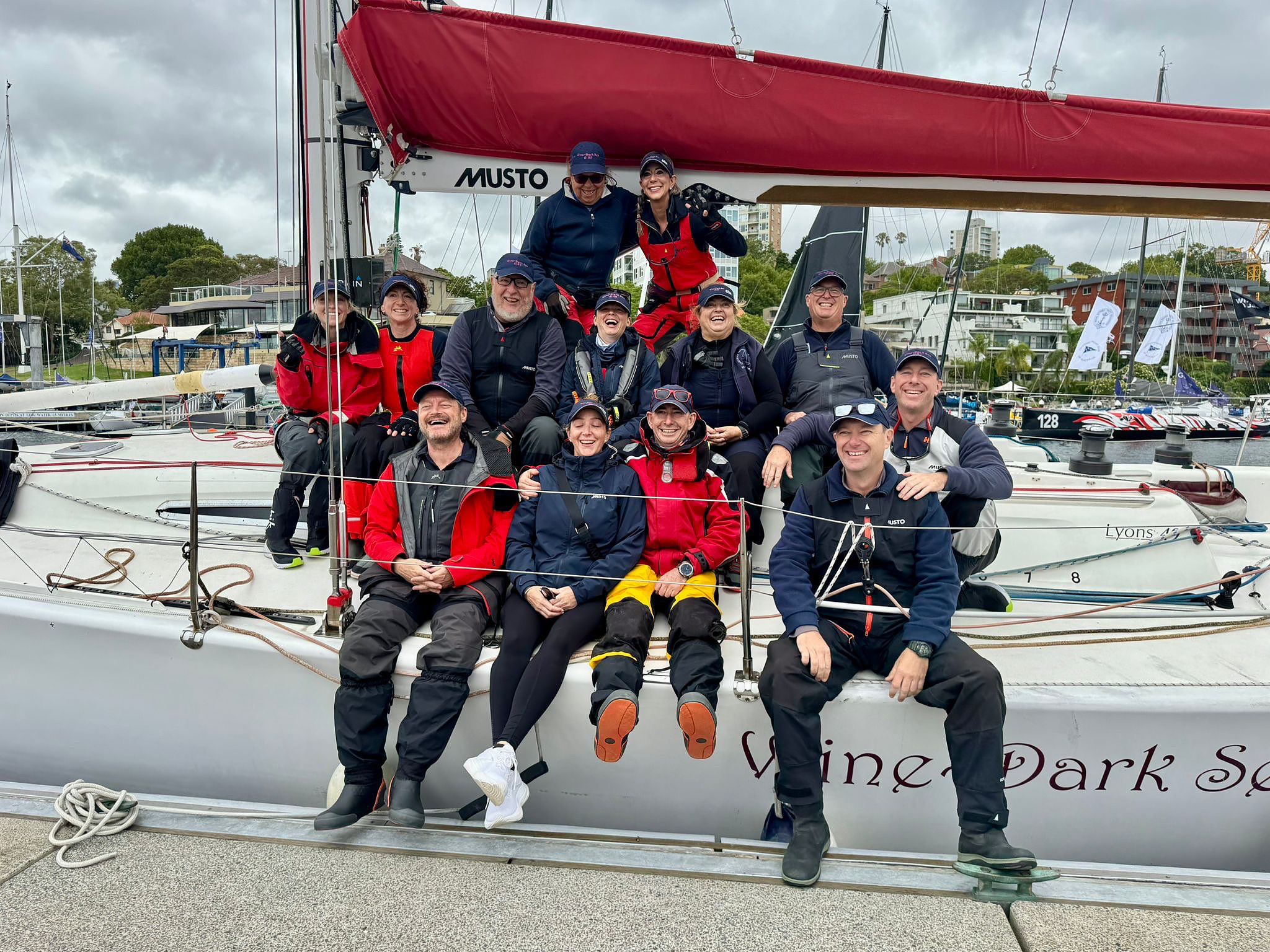
So we haven’t quite kept up with the blog scope but we’re back on it.
The Bluewater series was punctuated by several high points even if the results didn’t necessarily show it.
We had great starts in all the races. We even confused the commentators on the Cabbage Tree Island race as we had already passed a couple of Division 1 boats before we left the heads, even though they started 5 minutes in front of us. They quickly scrammbled to find who we were, they didn’t quite expect us to be there!
We had great upwind speed holding on to boats with much higher handicaps for what appeared to be a series dominated by upwind starting legs with downwind rides home to the finishes.
We learnt loads about the new sail wardrobe. We learnt big sails don’t always win big races.
Our biggest losses in the buildup to Hobart were based around poor sail choices, made by me (Peter). One was staying with a big symmetrical on the Flinders Island race as the wind clocked forward. If we had changed back to the asymmetric we would have been in control all the way to the finish. Instead we had a number of broaches and ultimately destroyed the spinnaker. The other was off the back of a good seamanship choice. In the Cabbage Tree Island race we decided to protect the new symmetrical spinnaker when the wind speed went through 25kts on it way to 30kts. We went to the jib for a while but as the wind backed off to mid to low 20’s I made the call for the spare symmetrical spinnaker. Poor driving, again by me, resulted in us being too low during the hoist and an almighty wrap around the forestay. After valiant efforts by everyone for over an hour there was only one thing left for it. I donned my ski helmet and climbing harness and went aloft to cut the spinnaker off the forestay. 45 minutes later I returned to the deck. Bruised, battered and exhausted to the point of heaving. Another spinnaker in the bin.
The lesson learnt. Choose the right shaped spinnaker for the angle of sailing. Not the biggest one available.
One of the best runs we had was just after we rounded Flinders Island. Wind was square but in the high 20’s. We had a feeling it was just a bit much for the symmetrical. We hoisted the A3 and blasted along as comfortable as can be. Much more so than a couple of hours later in 15-18kts when we blew up the symmetrical trying to hold it shy.
There were also some great seamanship lessons. The decision to drop out of Tollgate Island even before the start was totally the correct one. What seemed to be a minor failing of the stitching on an intermediate mainsail car would have ended up destroying the mainsail in what turned out to be an absolute fleet pounder of a race. Then there was Bird Island where we doused the spinnaker as we headed into a squall shortly after rounding the Island. Not 2 minutes later we got hit by 30+kts which pretty much stayed with us until the finish. The closest boats to us all lost sails and time.
So on to Hobart.
Before I start I will say that I have never seen a race plan to perfectly executed from start to, well you know what happened.
First some background. I had been working on the IRC handicap of the boat for, well, 15 years but more seriously since the carbon mast was installed in 2022. Through this process, and a recent IRC move to require the number of headsails to be declared, meant WDS is rated with a single, hanked on, reefing headsail and 3 spinnakers (Symmetrical, Asy and Code Zero). Offshore races are then allowed an extra headsail and spinnaker. We take an old 3+ headsail and another symmetrical spinnaker.
Given the forecast of high teens to mid 20s upwind for a couple of days off the start, the brains trust decided to take a bit of a risk. Use the “spare” #3 off the start and take the hit later in the race if we needed to change headsails. This being a half hour exercise to de-hank and rehank the headsails. That turned out to be a golden choice. Apart from a couple of lulls close to Jervis Bay, the wind was perfectly in the range for the #3 and gave us a much larger reefing window. This eliminated what probably would have been at least 3-4 reefing manoeuvres if we had go with the bigger headsail. I credit this decision with half the reason why we leading our division at the time of our ultimate demise. The rest, like a said at the outset was due to a great race made by the Brains Trust (Peter, Tony, Rich and James) and execution by the crew.
So what went wrong in Hobart.
One thing I will say about this Hobart is that it was relentless. My last tilt at Hobart (2004) was more extreme but the 60 knots only last a few hours. This was raceable but definitely overpowered upwind from the begining and was forecast to be relentless for at least 48 hours. This fed into a building seastate that inevitably caused its first casualties. Seasickness. Every crew generally has someone who gets seasick. We weren’t alone in this. The relentless nature of the race though meant everyone was at least one level worse than usual. Those that were usually “one and done” continued to get seasick. Those more prone to seasickness became incapacitated. In the end half the crew had recurring seasickness to some extent.
Then there was the large amount of water in the bilge. Wine-Dark Sea has two heads. Due to the design of the boat, like many, these sit below the waterline when the boat is heeled. This usually isn’t a problem but when the boat is heeled for hours on end on one tack and the boat is slamming over waves, the water comes in and fill the entire bathroom. Due to this, it is imperative that the seacocks are closed fully, especially on the leeward head. This wasn’t happening and as a result we had at least 300L of water enter via the aft head. There was so much water that it overflowed from the head and started to track along cable and pipe ducts to other compartments. The other problem being that when the boat is heeled the water flows to leeward and the bilge pump ends up above the water. So it was over to the manual bilge pumps, roving bilge pumps and water/dry vac. Due to sea sickness, there weren’t many crew that could deal with being below in that sea state to pump out the water. Thankfully Lindy doesn’t get seasick and is all too familiar with cleaning up shit! Lindy spent hours getting the water out of the boat.
Then we got the familiar whiff of diesel.
A recommendation by ‘someone’ to move the secondary anchor from where we usually keep it to the lazarette seemed like a good idea at the time. Separate locations meant we should always be able to get to anchor. It also moved some weight out of the bow. Both good things. However, even though it was tied in, it did shift slightly with the tacking and pounding into the seaway. As a result the anchor had knocked the lazarette bilge pump off it base. Ultimately the lazarette filled with water and the jerry can of diesel in the lazarette overturned and the breather cap came off. The diesel then attacked the seal on the aft watertight bulkhead and the diesel spread through the rest of the boat, mixing with the plentiful water in the bilge. Result – a skating rink downstairs and everything smelling of diesel. Combine the already seasick crew and the smell of diesel it was not making for a great race.
In the meantime I go to have a look at result, weather, and such things. Hmmm. No Starlink. Hmmm. No 240V. Ahh. The RCD has tripped. That’s right the thing that stops me electrocuting myself. Bugger it won’t reset. Well that’ll have to go then. I lop the end of my 15A shore power lead and wire of a 10A plug. Problem solved. Just run the extension cord straight to the Starlink. No safeties and a 240V power lead running through a leaky boat. What could possibly go wrong?
As it turned out nothing more from that. Now start the reports of salty freshwater. OK. Dump the tank, start the engine and make water for a couple of hours. Still salty. Move to emergency water rations with an intention to make more water the following day when the wind should shift further aft and the boat wouldn’t be slamming so much. Anything else. No. I’m going to bed.
Just as I drifted off I heard a sail flapping. Tacking? Wait. Too much flapping. I look up from my saloon berth to see the headsail coming down the forestay. Ah crap. As it turned out we hadn’t broken a halyard. We snapped clear through the headsail halyard clip.
I’d seen this movie before. Its called the Swiss Cheese model. We now had multiple failures of multiple systems and none of the fully fixed. The next one could be the clincher. I had made up my mind but we needed to make the decision as a crew. There was some optimism about our ability to fix things but the general consensus was the smart thing was to suspend racing and turn around. Suspending became retirement and that was that.
Wine~Dark Sea and her Crew turned around and made her way back to RSYS where we were met by the rest of the Wineo’s. After that, most of us flew to Hobart to join the rest of the fleet to celebrate a fantastic campaign. Each and everyone of the crew put everything they had into this campaign. Some new, some old. We made it to the dock with everyone in tact – just the wrong end.
We gave it a red hot go and proved that Wine-Dark Sea can sail to her rating. That is a win for me and for future programs.
The Crew:
Bow -Sarah “Snowy” Hall
Mid Bow – Emma Thomas
Mast – Doug “Daaady” Rayment
Pit – Larissa Chase
Grinder – Jefferson Welstead
Trimmer – Lindy “YKIMS” Hardcastle
Trimmer – Richard “The Consultant” Wulff
Trimmer – Sylvie Godquin
Trimmer – Rachael Scott
Main – James Hall
Tactician – Tony “The Other” Wulff
Skipper – Peter “Cap’n” Lowndes
Champagne Manager – Courtney Lowndes
The washup
The salty freshwater was due to a 1c zip tie that held the freshwater tank breather hose in an anti-syphon loop failing.
The 240V failure was a 24 year old panel that had just corroded over time and developed unsafe earth leakages
The broken headsail clip. Same story. 24 years old but no visual signs of failure.
The secondary anchor is back where it belongs and the primary anchor is on the bow. Ready to go cruising.

